#include <socket.hpp>
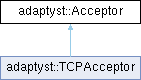
Classes | |
| class | Factory |
Public Member Functions | |
| std::unique_ptr< Connection > | accept (unsigned int buf_size, long timeout=NO_TIMEOUT) |
| virtual | ~Acceptor () |
| virtual std::string | get_connection_instructions ()=0 |
| virtual std::string | get_type ()=0 |
Protected Member Functions | |
| Acceptor (int max_accepted) | |
| virtual std::unique_ptr< Connection > | accept_connection (unsigned int buf_size, long timeout)=0 |
| virtual void | close ()=0 |
Detailed Description
A class describing a connection acceptor.
Constructor & Destructor Documentation
◆ Acceptor()
|
inlineprotected |
Constructs an Acceptor object.
- Parameters
-
max_accepted A maximum number of connections that the acceptor can accept during its lifetime. Use UNLIMITED_ACCEPTED for no limit.
◆ ~Acceptor()
|
inlinevirtual |
Member Function Documentation
◆ accept()
|
inline |
Accepts a new connection.
If the maximum number of accepted connections is reached, a runtime error is thrown immediately.
- Parameters
-
buf_size The buffer size for communication, in bytes. timeout The maximum number of seconds the acceptor will wait for to accept a connection. Afterwards, TimeoutException will be thrown. Use NO_TIMEOUT to wait indefinitely for a connection.
- Exceptions
-
std::runtime_error When the maximum number of accepted connections is reached. TimeoutException When the timeout is reached.
◆ accept_connection()
|
protectedpure virtual |
An internal method called by accept() accepting a new connection.
It should always return the new connection, regardless of the number of connections already accepted by the object.
- Parameters
-
buf_size The buffer size for communication, in bytes. timeout The maximum number of seconds the acceptor will wait for to accept a connection. Afterwards, TimeoutException will be thrown. Use NO_TIMEOUT to wait indefinitely for a connection.
Implemented in adaptyst::TCPAcceptor.
◆ close()
|
protectedpure virtual |
Closes the acceptor.
Implemented in adaptyst::TCPAcceptor.
◆ get_connection_instructions()
|
pure virtual |
Gets the instructions how the other end of the connection should connect to this end so that accept() can return a Connection-derived object.
These are in form of a "<field1>_<field2>_..._<fieldX>" string, where the number of fields and their content are implementation-dependent.
Implemented in adaptyst::TCPAcceptor.
◆ get_type()
|
pure virtual |
Gets the string describing the connection type of the acceptor (e.g. TCP).
Implemented in adaptyst::TCPAcceptor.
The documentation for this class was generated from the following file:
- adaptyst/socket.hpp
Generated by
 1.15.0